 Store
Store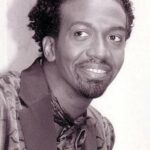
Edwin Lacend
1960–2013
Edwin Lacend (1960, Puerto Rico–2013, New York, NY) was a figurative painter whose striking use of color, illustrative style, and dazzling ornamentation was influenced by his work with costume design. In his paintings, sleek Black figures preen and vogue against color-field, pointillist, and geometric backdrops that make reference to Keith Haring’s graphic style and Jackson Pollock’s all-over compositions. Borrowing from the aesthetics of fashion editorials, Lacend’s often female subjects are richly dressed, elegantly coiffed, and dripping with jewelry—performing self whether in domestic space or against obscure natural landscapes. Some works make reference to musical acts such as Christafari and the Supremes. Others turn to Lacend’s Puerto Rican roots. In one drawing, the face of an abstracted figure melts away to reveal a tropical coastline; along the left edge of the canvas, the work’s title Boriqua runs in varicolored block letters.
Lacend attended Parsons School of Design for his undergraduate degree. In his personal life and career, he worked in costume design, serving on the wardrobe teams for television shows such as The Fabulous Reggae Dogs and personally participating in events such as the George Paul Rozell Fantasy Ball. His visual work was shown throughout New York City, appearing in exhibitions and displays at a range of venues, including Artists Space, the Williamsburg Art and Historical Center, the Lenox Lounge Jazz Hall of Fame, the East Harlem branch of Popular Bank, Edwin’s Beauty Supplies Y Mi Salon Unisex, and the Queens Independent Living Center. He was also included in Release II, an exhibition coordinated by Visual AIDS in partnership with the Museum of Contemporary African Diasporan Arts (MoCADA) in 2005.


The next best thing to traveling is having an imagination. I've traveled in my mind far and long distances - and have accumulated quite a bit of frequent flyer miles...
"Why do I paint?" First, I paint because I can and learned how. I suppose the next question is how I learned to draw. The answer is simple yet complicated. I was drawn to draw. My the earliest recollection of how I was drawn would be directly linked to my nuclear family. What I remember is real to me. I remember at the age of about three, or maybe four, when my mother would gather us up on the kitchen table on East 112th Street in Spanish Harlem. There, my mother would stimulate and stir the passion that I now know were the roots of who I have become as an artist. I am the youngest of four, a set of twin brothers and a sister four years my senior.